How much does an IVF baby cost?
This Abstract was written and presented by Dr. Vasiliki A. Moragianni of Boston IVF at ASRM 2012.

AUTHORS: Vasiliki A. Moragianni, MD, MS1,2, Konstantinos N. Aronis, MD3, Denny Sakkas, PhD2, Alan S. Penzias, MD1,2, Michael M. Alper, MD1,2. 1Division of Reproductive Endocrinology & Infertility, Department of Medicine, Beth Israel Deaconess Medical Center, Harvard Medical School, Boston, MA; 2Boston IVF, Waltham, MA 02451; 3Department of Medicine, Boston Medical Center, Boston University, Boston, MA.
TITLE: How much does an IVF baby cost? The Boston IVF experience.
OBJECTIVE: Numerous models have been proposed to assess the efficiency of IVF. One question that arises consistently is the cost effectiveness of continually pursuing routine IVF treatment or adding a more complex technology to a routine treatment. As an initial step to answer these questions we have determined the cumulative cost of achieving live birth from IVF.
DESIGN: Retrospective time to event analysis.
MATERIALS AND METHODS: We analyzed a total of 49,530 autologous fresh or frozen IVF cycles from 21,155 patients that were treated in our clinic between 01/1995 and 12/2011.The cost per cycle (in USD) was as follows: (a) fresh=$8300, and (b) frozen=$3000+$65 per month since last fresh IVF cycle (storage fee). We calculated the total amount each patient spent to achieve a live birth. We performed a Cox proportional hazard analysis to evaluate the hazard ratio (HR) across different age strata: <30, 30-35, 36-40, and >40yo. We also performed accelerated time ratio parametric survival models to evaluate the effect of age on the cost required to achieve the same success rate.
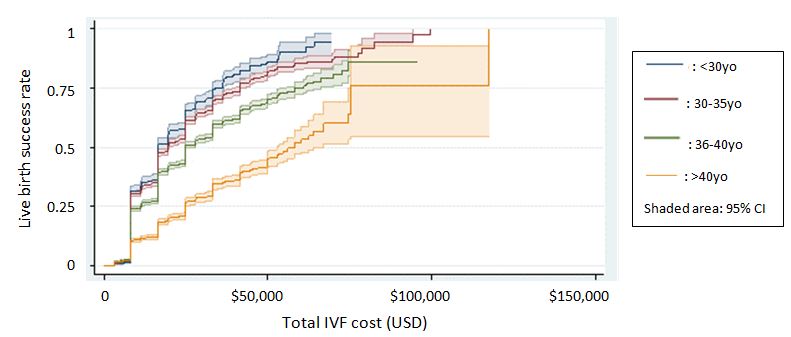
RESULTS: Figure 1 summarizes the total IVF cost corresponding to live birth success rates per age strata. When compared with patients <30yo, the HR (95%CI) of the 30-35 age group was 0.91 (0.86-0.97), of 36-40: 0.70 (0.66-0.75) and of >40: 0.33 (0.30-0.35). Similarly, the cost ratio of 30-35 was +6%, of 36-40 +27% and of >40 +107%. For instance, after spending $12K (one fresh and the ensuing frozen cycle), a <30 patient had a 32% chance of live birth, in 30-35 30%, in 36-40 25%, and in >40 13%.
Figure 1. Age-stratified Kaplan-Meier curve of live birth success rate vs. IVF cost (in USD).

CONCLUSIONS: Our models demonstrate that patients over 40yo who spend the same amount as their younger cohorts for IVF treatment have a 77% lower chance of achieving a live birth. Moreover, to achieve similar success rates as younger patients they need to spend 107% more. Our results will be further utilized to evaluate the cost effectiveness of treatment or novel adjuvant technologies, such as aneuploidy screening, utilized in ART.